Shipping Production AI in Enterprise: A Practical Delivery Framework
Most enterprise AI projects don’t fail at proof-of-concept. They fail at production. The model works in the sandbox, the demo lands well, and then six months later the project is stalled — blocked on data access, integration complexity, governance sign-off, or an architecture that was never designed to run at scale.
This is a delivery framework. Not a primer on why AI matters. It’s a structured approach to scoping, prioritising and shipping AI systems in organisations where “it works in my notebook” is not an acceptable outcome.
The Delivery Failure Pattern
Technically capable teams still produce failed AI projects. The common failure modes aren’t about model quality or prompt engineering. They’re delivery failures:
- Systems built in isolation from the integration surface they’ll need to serve
- No baseline measurement, so you can’t prove or improve outcomes after launch
- Governance and compliance requirements discovered late, causing scope rewrites
- Observability bolted on after the fact, or not at all
- Handover documentation that doesn’t exist, or doesn’t reflect what was actually built
The fix isn’t more tooling. It’s structured delivery from the start.
Mapping Your Integration Surface
Before writing code, map the systems your AI needs to touch. In enterprise environments, this is rarely one data source and one output target. It’s CRMs, identity providers, event streams, legacy APIs, content stores and approval workflows, many of which have their own access controls, rate limits and data contracts.
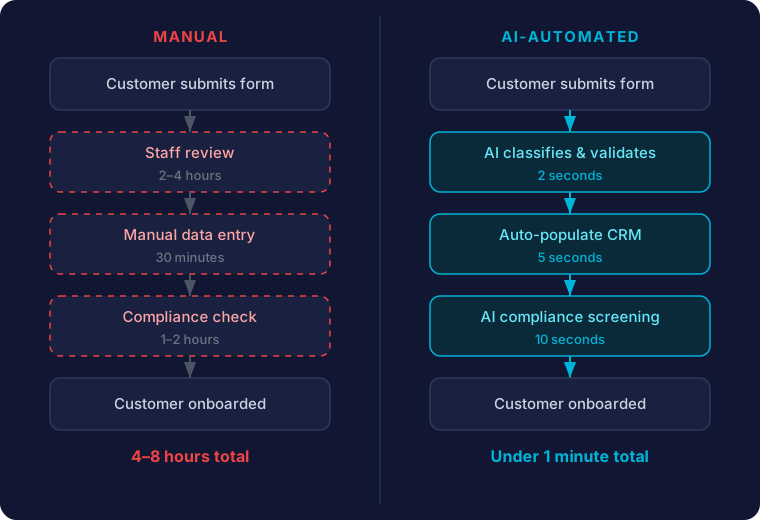
The workflow diagram above illustrates a typical before/after. What it doesn’t show is the integration work behind the automated side: auth flows, schema normalisation, error handling, retry logic and the human escalation path for edge cases.
Scoping that surface early determines your delivery timeline, your risk profile and which systems need stakeholder alignment before you start.
Assessing Readiness Honestly
We use a five-level maturity model when scoping AI work with engineering teams. Most organisations sit at Level 1 or 2, not because they haven’t invested in AI, but because foundational data infrastructure is underdeveloped.
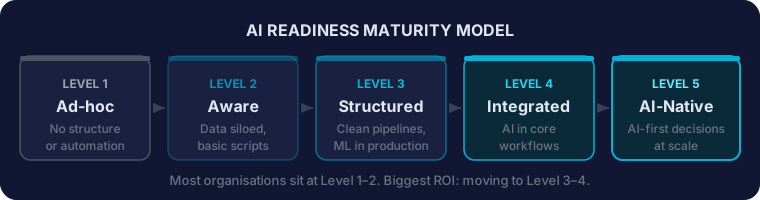
The maturity assessment isn’t about gatekeeping. It’s about identifying the load-bearing constraints before they surface mid-project. A team at Level 2 can ship production AI, but only if the delivery plan accounts for the gaps. Pretending those gaps don’t exist is how you end up rebuilding the data pipeline in week 8 of a 10-week engagement.
Sequencing the Work
Not every AI use case should be built first. The highest-ROI starting points share a common profile: high volume, well-defined logic, good data quality and a clear success metric. These are the cases where you can ship fast, prove value and build the organisational trust needed to tackle harder problems.
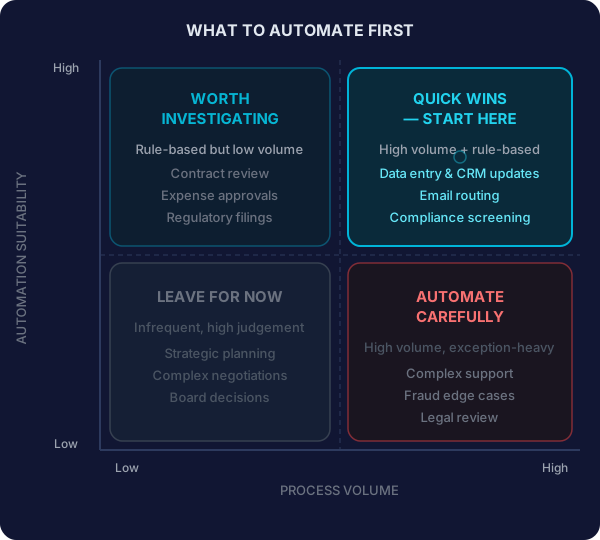
The two-axis matrix above maps process volume against automation suitability. The top-right quadrant is where you start, not because those problems are easy, but because they’re well-bounded. Bounded problems ship.
Low-frequency, high-judgement processes belong in a later phase. Not because AI can’t help, but because the risk profile in complex organisations requires a track record before you can get the right stakeholders to commit.
Delivery Phases That Control Risk
The four-phase delivery model below is designed for organisations where ungated delivery is not an option. Each phase has a defined output and a decision gate before the next begins.
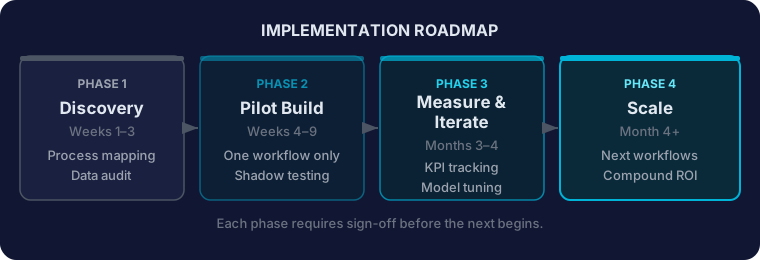
Phase 2 is deliberately constrained to a single workflow. The goal is a production system that runs, observes and can be handed over, not a prototype that needs six months of hardening before it’s usable. That single-workflow proof is what justifies Phase 4 resource commitment.
Human-in-the-loop checkpoints are designed in from the start. In regulated or high-stakes environments, designing for oversight is a delivery requirement, not an afterthought.
Measuring Outcomes
Hard measurement is non-negotiable for enterprise AI programmes. Not just because finance wants a number, but because without baselines you can’t improve what you’ve built or justify what comes next.
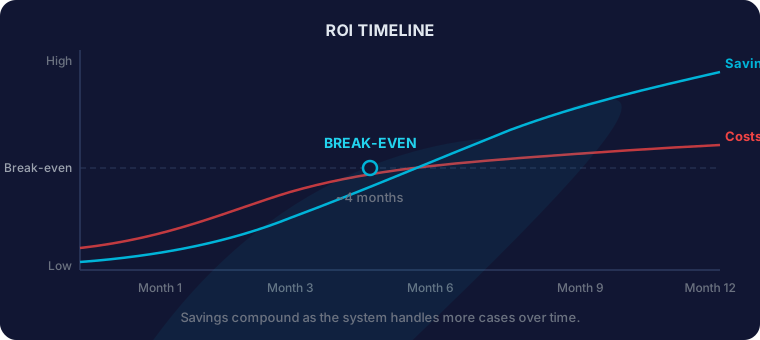
Break-even at 3 to 5 months is achievable when scope is controlled and baselines were measured before delivery started. Organisations that skip baseline measurement almost always struggle to quantify value at the end, and struggle to fund the next phase as a result.
Track the metrics that matter for your specific workflow: time-to-completion, error rate, human escalation rate, throughput. Pick three. Measure them before you build. Measure them after.
Starting Well
If you’re scoping AI work in a complex organisation:
- Map your integration surface before scoping the model — know what systems, auth patterns and data contracts you’re working against
- Assess data quality before committing to a timeline — poor data quality is the single most common delivery delay
- Pick one workflow for the pilot, and make it well-bounded — scope creep in Phase 1 kills Phase 4
- Design observability in from the start — you can’t debug a production system you can’t observe
- Plan the handover before you start building — documentation and enablement are delivery requirements, not optional extras
Working With Us
Killawot embeds senior engineers with your team to move AI projects from scoping to production. If you’re planning an AI delivery programme and want a senior technical perspective on the approach, book a technical discovery call.